
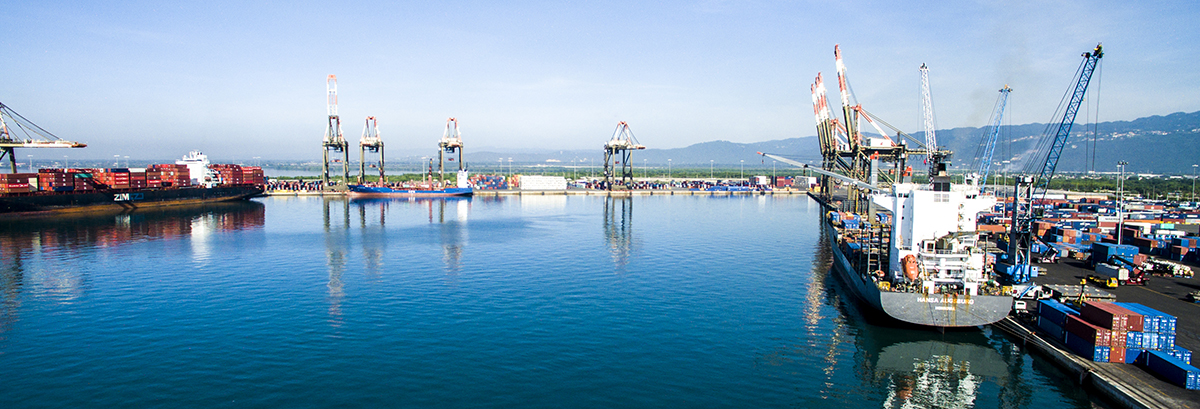
The Port of Kingston has been on a journey of transformation spurred by the Shipping Association of Jamaica’s mission to advance it’s evolution as a major maritime logistics hub of the Caribbean.
But let us start at the beginning…
No story of shipping in Jamaica could be properly told without examining the role of the great harbour of Kingston. The Port of Kingston has always been the hub of trade with several periods governing its development:
- 1692-1713 – The early freebooters
British Governments, Jamaican Governors, pirates, buccaneers and privateers plundered and brought fortunes to Kingston to finance imports from North America and Britain. - 1713-1759 -The Asiento Trade
When the British got exclusive right to supply Spanish America with some products, Jamaican planters objected to the competition, but trade developed earning vast sums for the port and created fortunes in Britain. - 1766-1822 – Kingston as a Freeport
During this period, Kingston was said to be among the principal ports in the Western Hemisphere, and the main source of coins for the British Empire. - 1860-1912 – Opening of Central America
When it was decided to cut a canal across the Isthmus of Central America, Kingston became a primary source of supply of labour for the canals, railways, and the introduction of banana cultivation by American companies who found Jamaica too small for their operations. This trade brought new influences into Jamaica – George Stiebel from Venezuela and Cecil Lindo from Costa Rica. - 1939-1944 – WWII
With the closure of the Atlantic merchant shipping lanes, Kingston port flowered into a range of activities as a new coastal trade was renewed among Jamaican ports; and small boats started trading with other Caribbean ports as new sources of goods were sought.
Jamaica has made significant strides in the global maritime sector and has been called the most developed marine administration in the Caribbean. The country is home to a very vibrant and robust shipping industry. Kingston boasts the seventh largest natural harbour in the world and consists of an almost landlocked area of water, roughly ten miles long and two miles wide. Much of this water, even close to shore, is deep enough to accommodate large ships. There has consequently been a whole series of wharf facilities within the Port of Kingston.
In its first 30 years, Kingston was merely one of the four ports in Kingston Harbour, the other three having been built prior to 1692. These were Port Royal (Fort Cagway), which relinquished its primacy only after visitations of earthquake, fire and tidal waves; Passage Fort, which was the main port of receiving goods for the capital of Spanish Town; Rockfort, which was a main watering place for vessels and was a small township before Kingston was founded.
When Port Royal was extensively damaged in the earthquake of 1692, the future site of Kingston began to be heavily settled, even though it was not nearly such a convenient place for the berthing of ships.
Had it not been for outports like Morant Bay, Annotto Bay, Port Maria, St. Ann’s Bay and Montego Bay, the pace of Kingston’s port development in the first half of the 18th Century would have been even faster. As it was, Kingston expanded at a reasonable rate, with an increasing number of wharves.
By 1750, Kingston was the only port of any significance in Kingston Harbour, and no less than 14-finger piers had been built along the lands that Sir William Beeston had dumped at the turn of the Century. These finger piers allowed a large number of vessels to be berthed near the source of the best navigational water and the warehouses and stores where the ships’ agents and merchants were located.
Kingston’s growth reflected an increase in mercantile activity as the city grew. The decline of the outposts was related to the fortunes of agriculture. As ships grew larger and Jamaica’s internal communications more extensive, the outports went into decline from which Kingston greatly benefited. By 1910, the wharves and the shipping lines serving them, had begun to export bananas, citrus, and offer Sea Passage to tourist & expatriate teachers to and from the UK.
One of the great disadvantages of the old finger-piers was that they concentrated a large number of ships on a relatively small area of shoreline. This might have been advantageous in a harbour short of deep berths and adequate access routes, but it proved a crippling disadvantage to Kingston, whose roads leading to the harbour had not been designed to take this kind of traffic.
By the mid-1950’s it was obvious that some solutions would have to be found for the problems of Kingston’s port which was becoming increasingly inadequate for the rising tide of goods flowing through it. After Hurricane Charlie in 1951, and the development of the Kingston Industrial Estate in 1952, business in Kingston boomed, especially imports, which benefited from the vast earnings of the new bauxite industry.
But downtown Kingston, laid out with narrow streets by Goffe in 1692 could not absorb the traffic. The waterfront became a nightmare of mule-drawn drays, handcarts, motor trucks, and vans of all sizes, together with passengers of ships coming to have a peek at the City. Overcrowding was endemic, movements were slow, spoilage, spillage and slippage were the norm rather than the exception, and clearly something new was required.
It was clear that a solution had to be found as the 15 wharves were in a state of chaos. Moses Matalon, a young Jamaican engineer, suggested removal to the Hunts Bay section in the Western Harbour, bounded by a swamp, then used as a dump for the City’s refuse. It provided:
- 8,000 feet of deep-water frontage
- Seven deep-water berths
- Four Hundred acres of new land to house the warehousing, offices and factories needed to service, and be serviced, by a great Port.
The owners of the 15 abandoned wharves were consolidated in two groups – Kingston Wharves headed by Grace, Kennedy; and Western Terminals which included the Lascelles and Matalon interests. The Government acquired 176 acres of the dumped land as its fee, and this section provided two new useful facilities at Newport West: The Container Port, using the new gantry crane mass movement system in a duty-free customs area and the Kingston Freezone which houses export manufacturing operations.
The first major innovation at the new Port, was the development of a Roll-on/Roll-off facility by Western Terminals at Berth No.1, which greatly increased the capacity of the port to speedily handle cargo.
The two companies which agreed to operate Newport West (NPW) were Kingston Wharves and Western Terminals. The first of these had already been operating six of the Finger-Piers, and included several companies namely Grace Kennedy, Jamaica Fruit and Royal Mail. The second, Western Terminals, brought together Lascelles de Mercado, the Henriques and Matalon Groups of Companies.
Engineering work went on throughout 1965. On February 14, 1966, the first ship to dock at NPW was the SS United States, one of the largest to visit Jamaica. Between 1966 and 1971, the old piers would be mostly abandoned. As these old wharves gave way to modern facilities at Newport West, the ability to handle more diverse lines of cargo increased. The port, now renamed Port Bustamante, in honour of the great labour leader and National Hero, Sir Alexander Bustamante, can accommodate most of the larger vessels in ocean commerce today.